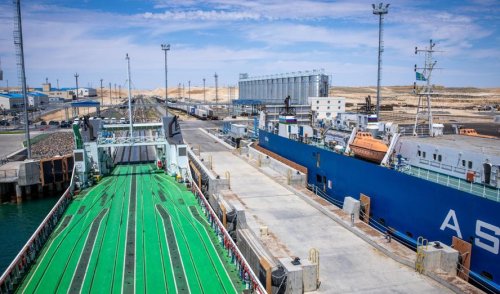
The Rise of Middle Corridor Geopolitics - Trans-Caspian Route
The Middle Corridor linking China to Europe via Central Asia, the Caspian Sea, the Caucasus, and Turkey is rapidly gaining importance as an alternative to Russia-centric routes. With shifting sanctions, supply chain disruptions, and regional ambitions, this corridor is becoming a strategic battleground for influence, infrastructure investment, and economic alignment. Key angles: Role of Turkey, Azerbaijan, and Central Asian states Competition with Belt and Road Initiative routes Strategic implications for Europe-Asia trade


Rewiring Eurasia: The Strategic Rise of the Middle Corridor
Eurasia Geopolitical Strategy and Policy Institute (EGSPI)
Executive Summary
The Middle Corridor, stretching from East Asia through Central Asia, across the Caspian Sea, through the South Caucasus, and into Europe, is no longer a peripheral trade route. It is becoming a strategic necessity.
Driven by geopolitical fragmentation, sanctions regimes, and a growing awareness of supply chain vulnerability, states and institutions are beginning to re-evaluate how Eurasia connects. What was once considered inefficient, fragmented, even impractical, is now being actively developed, funded, and politically supported.
This report examines the structural emergence of the Middle Corridor, its strategic relevance, its limitations, and its long-term implications for Eurasian power dynamics.
1. Introduction: When Routes Begin to Shift
For years, the architecture of Eurasian trade felt almost fixed.
Rail lines moved north. Energy flowed along established pipelines. The system was not perfect, but it was understood. Predictability, even when fragile, creates its own kind of stability.
Then something began to change.
It did not happen overnight. There was no single turning point that redrew the map in one clean motion. Instead, it came in layers. Sanctions tightening. Political distrust deepening. Governments, quietly at first, began asking a different kind of question. Not what is the fastest route, but what is the safest one to depend on.
That distinction matters.
And somewhere in that shift, the Middle Corridor began to move. Slowly. Then more visibly.
2. Defining the Middle Corridor
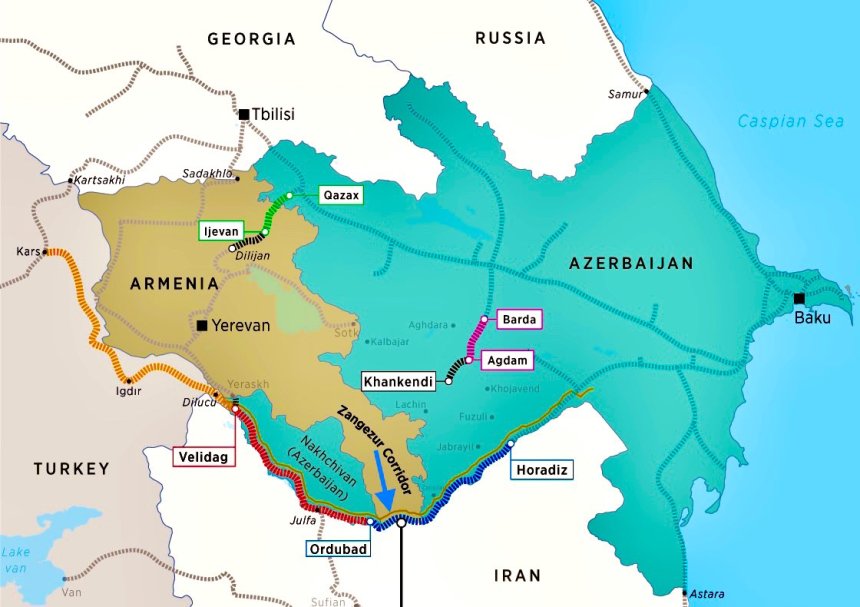
The Middle Corridor, often referred to as the Trans-Caspian International Transport Route, connects East Asia to Europe through a combination of rail, maritime, and road networks. It passes through Central Asian states, crosses the Caspian Sea, continues through the South Caucasus, and enters Europe via Turkey.
Unlike northern routes that pass through Russia, or southern alternatives that rely heavily on maritime chokepoints, the Middle Corridor is inherently multi-modal. That is both its strength and its weakness.
It is not one line. It is a system.
And systems require coordination.
3. Why It Matters Now
The renewed relevance of the Middle Corridor cannot be understood without acknowledging the broader geopolitical climate.
Sanctions on Russia following the war in Ukraine did more than isolate a state. They disrupted assumptions. For decades, infrastructure built through Russian territory was considered reliable, if not politically neutral. That perception has changed.
At the same time, European actors have begun seeking diversification, not just in energy, but in logistics. Dependence, once tolerated, is now treated as risk.
Meanwhile, global supply chains, already strained by the pandemic, revealed just how fragile interconnected systems can be. Delays, bottlenecks, unexpected closures… these are no longer abstract concerns. They are operational realities.
In this environment, redundancy becomes strategy.
The Middle Corridor offers exactly that. Not perfection, not efficiency in the traditional sense, but optionality. And in geopolitics, optionality is power.
4. Strategic Actors and Their Roles
No corridor exists in isolation. It is shaped by the intentions and capabilities of the states it passes through.
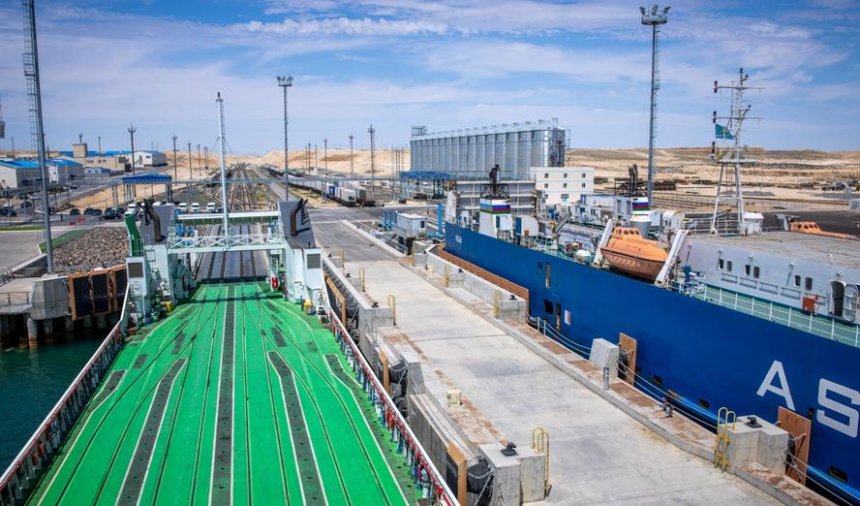
Azerbaijan has emerged as a central node, particularly in facilitating transit across the Caspian. Its investments in infrastructure and logistics positioning reflect a broader ambition to act not just as a transit country, but as a regional hub.
Further west, Turkey plays a critical role as the corridor’s gateway into Europe. Its geographic position is obvious. What is less obvious, but increasingly important, is its strategic balancing act between East and West.
Central Asian states, often viewed historically as peripheral, are now finding themselves in a different position. Not dominant, not controlling, but necessary. And necessity, in geopolitics, has a way of reshaping influence.
5. Structural Challenges
Despite its promise, the Middle Corridor is far from seamless.
Infrastructure gaps remain significant. Rail compatibility issues, port limitations, and capacity constraints continue to slow transit times. The Caspian crossing itself introduces a layer of complexity that cannot be ignored.
Then there is the issue of coordination.
Each segment of the corridor operates under different regulatory frameworks, customs procedures, and political priorities. What looks like a single route on a map is, in practice, a chain of negotiations.
And chains are only as strong as their weakest link.
There is also a quieter challenge. Trust.
States cooperating today may not align tomorrow. Agreements exist, but they are often contingent, shaped by shifting alliances and internal pressures.
6. Economic and Political Implications
If successfully developed, the Middle Corridor has the potential to redistribute economic activity across Eurasia.
Transit states stand to gain not only revenue, but leverage. Infrastructure becomes influence. Routes become bargaining tools.
At the same time, established routes may face gradual erosion of their dominance. Not collapse, but competition. And competition introduces uncertainty into previously stable systems.
For Europe, the corridor offers diversification. For Asia, it offers access. For intermediary states, it offers relevance.
But relevance comes with responsibility.
7. The Broader Strategic Picture
It would be a mistake to view the Middle Corridor purely through an economic lens.
This is not just about goods moving from one point to another. It is about the reconfiguration of space, influence, and dependency.
Corridors shape behavior. They influence alliances. They create new centers of gravity.
And perhaps most importantly, they redefine what is considered central and what is considered peripheral.
In that sense, the Middle Corridor is not just a route. It is a signal.
8. Conclusion: Not Inevitable, But Emerging
The rise of the Middle Corridor is not guaranteed.
There are too many variables. Too many points of friction. Too many uncertainties that cannot be engineered away.
And yet, something is happening.
You can see it in investment patterns. In diplomatic language. In the way policymakers speak, sometimes carefully, about alternatives that did not seem viable a decade ago.
The map is not being redrawn in bold lines. Not yet.
But it is being reconsidered.
Quietly. Gradually. In ways that may only become fully visible years from now.
And when they do, the Middle Corridor will not appear as something new.
It will look like something that was already underway.
EGSPI Note
This report is part of EGSPI’s ongoing research into emerging geopolitical structures across Eurasia, with a focus on strategic corridors, regional power dynamics, and long-term policy implications.
Share
What's Your Reaction?
 Like
0
Like
0
 Dislike
0
Dislike
0
 Love
0
Love
0
 Funny
0
Funny
0
 Angry
0
Angry
0
 Sad
0
Sad
0
 Wow
0
Wow
0