The Future of the South Caucasus After Nagorno-Karabakh
Following the collapse of the separatist structure in Nagorno-Karabakh, the region is entering a new phase of uncertainty. Questions around borders, corridors, and long-term peace remain unresolved. Key angles: Zangezur Corridor dynamics Relations between Armenia and Azerbaijan Influence of Russia, Iran, and Western actors

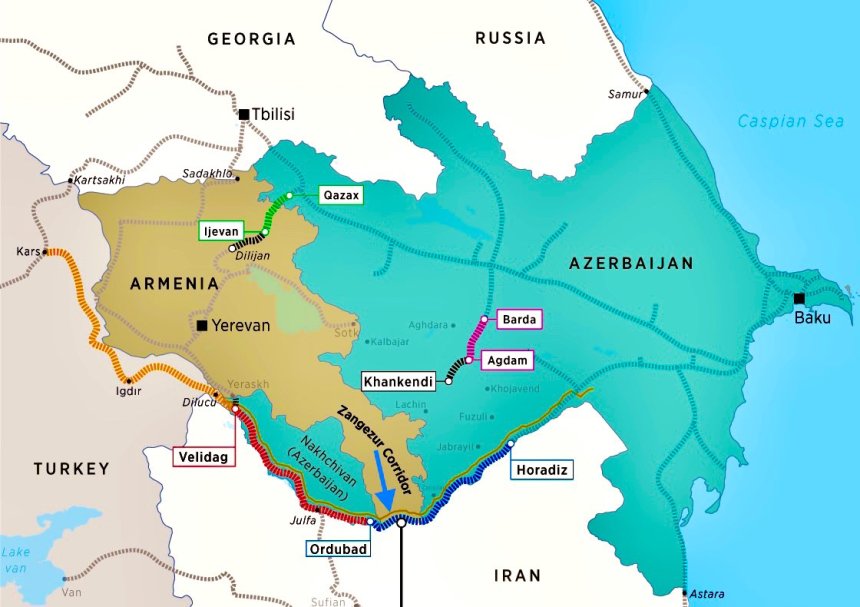
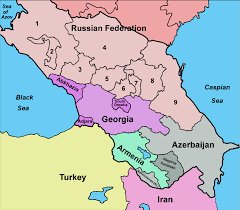
After Nagorno-Karabakh: Power, Corridors, and the Unfinished Peace
Eurasia Geopolitical Strategy and Policy Institute (EGSPI)
Executive Summary
The aftermath of the Nagorno-Karabakh conflict has not produced a stable peace. It has produced a new reality—one defined by shifting borders, fragile diplomacy, and competing visions of regional order.
The dissolution of the separatist structure in Nagorno-Karabakh has altered the strategic balance in the South Caucasus. Yet the core questions remain unresolved. How will Armenia and Azerbaijan redefine their relationship? What role will external actors play? And perhaps most critically, will emerging transport corridors stabilize the region or deepen new forms of competition?
This report examines the evolving geopolitical landscape of the South Caucasus, with particular focus on corridor politics, regional power dynamics, and the risks embedded in an incomplete peace.
1. Introduction: The War Ended. The Questions Didn’t.
Conflicts rarely end as cleanly as maps suggest. Lines are drawn. Statements are issued. Control shifts. And from a distance, it can look like resolution. But up close, the reality feels different. Uneven. Unsettled. The end of the conflict in Nagorno-Karabakh did not close a chapter. It exposed the next one. And that chapter is still being written.
2. A New Strategic Landscape
The South Caucasus has entered a period of recalibration.
Azerbaijan has consolidated territorial control, fundamentally altering the balance that existed for decades. This is not just a military outcome. It is a political one, with long-term implications for sovereignty, identity, and regional alignment. At the same time, Armenia faces a period of internal and external reassessment. Security assumptions that once seemed stable are now being questioned. Alliances are being reconsidered, not always publicly, but unmistakably. This is what post-conflict looks like when the conflict itself was never fully resolved.
3. The Central Issue: Corridors and Connectivity
At the heart of the current tension lies a deceptively simple concept.
Connectivity.
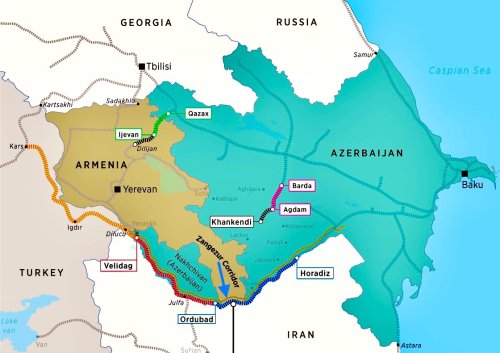
The proposed Zangezur Corridor has become one of the most debated elements of the post-conflict environment. For some, it represents economic opportunity, regional integration, and strategic linkage between East and West. For others, it raises concerns about sovereignty, territorial integrity, and long-term control. That duality is important. Because the same project can stabilize… or destabilize… depending on how it is implemented.
4. External Actors and Strategic Influence
The South Caucasus does not operate in isolation. Russia, traditionally a dominant security actor in the region, now faces a more complicated role. Its influence remains, but its capacity to shape outcomes is increasingly constrained. Iran views developments along its northern border with heightened sensitivity, particularly any changes that could affect transit routes or regional balance. Meanwhile, Western actors are engaging more actively, though often cautiously, attempting to support stability without becoming directly entangled. The result is a layered geopolitical environment where local dynamics intersect with broader strategic competition.
5. Risks of an Unfinished Peace
Peace agreements can end violence. They do not always resolve tensions.
1. Political Fragility
Domestic pressures within both Armenia and Azerbaijan could influence how agreements are interpreted or implemented.
2. Corridor Disputes
Disagreements over transit rights, control, and security mechanisms may become focal points of future friction.
3. External Competition
Diverging interests among regional and global actors could complicate stabilization efforts.
4. Perception vs Reality
Even where agreements exist, mistrust can persist. And mistrust has a way of shaping outcomes as much as formal policy.
6. Opportunity Amid Uncertainty
Despite the risks, the current moment also presents an opportunity. If managed carefully, new transport routes could transform the South Caucasus into a connective hub rather than a contested frontier. Economic interdependence, while not a guarantee of peace, can create incentives for stability. But this depends on something difficult to measure.
Restraint. And coordination.
7. Strategic Outlook
The future of the South Caucasus will not be determined by a single agreement or initiative.
It will emerge from a series of decisions. Some public. Some quiet. Some deliberate. Others reactive.
What is clear is this:
The region is no longer frozen.
And movement, while necessary, introduces uncertainty.
8. Conclusion: Stability Is Not Yet Secured
It is tempting to frame the post-Nagorno-Karabakh moment as resolution.
It is not.
It is transition.
The structures that defined the past have changed. The structures that will define the future are not yet fully formed.
And in that space… between what was and what will be… lies both risk and possibility.
The outcome is not predetermined.
It will depend on choices still being made.
EGSPI Closing Note
This report is part of EGSPI’s continuing research into geopolitical transformation across Eurasia, with particular focus on post-conflict environments, strategic corridors, and regional power dynamics.
Share
What's Your Reaction?
 Like
0
Like
0
 Dislike
0
Dislike
0
 Love
0
Love
0
 Funny
0
Funny
0
 Angry
0
Angry
0
 Sad
0
Sad
0
 Wow
0
Wow
0